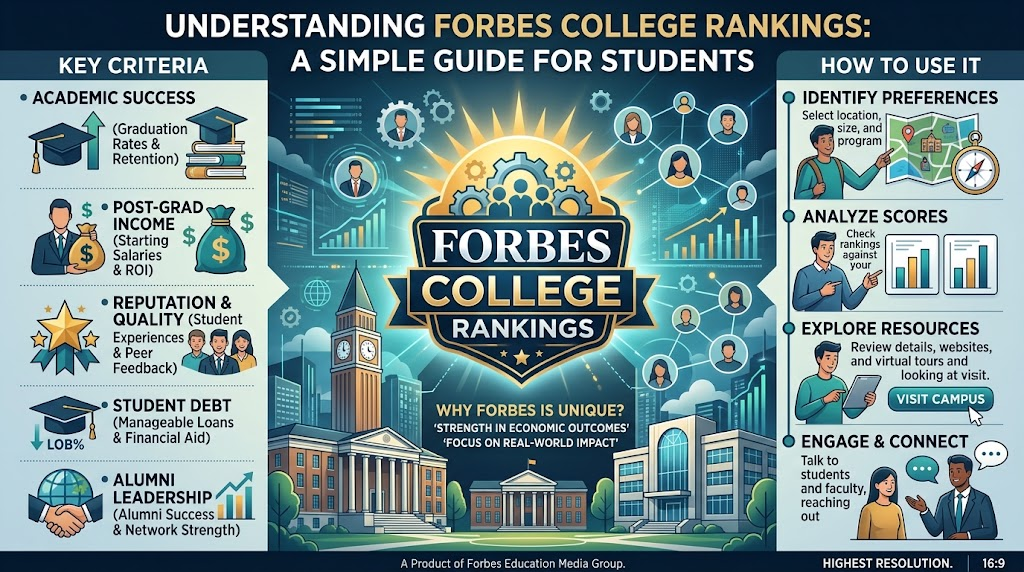
When you start thinking about your future, picking the right school feels like a huge choice. Many students look at Forbes College Rankings to see which schools stand out. Unlike other lists that focus only on test scores, Forbes looks at real-world value. They want to know how much money graduates make and how much student debt they carry. This makes the list very helpful for families who want a good return on their hard-earned money. When I first looked at these lists with my family, we were surprised to see how much costs and career paychecks varied between schools. By focusing on student success after graduation, this guide will help you understand how these famous educational scorecards work.
Why Student Debt and ROI Matter Most
Money is a big deal when you go to college. That is why forbes college rankings place a huge focus on student debt and return on investment, also known as ROI. If a school costs a fortune, but graduates cannot find good jobs, it might not be the best choice. Forbes checks how much debt students leave school with. They also look at median salaries years later. In my experience talking to recent graduates, avoiding massive loan payments takes a massive weight off your shoulders. Schools that rank high on this list often do a great job of keeping costs reasonable while helping students land solid careers. It is all about making sure your education pays off in the long run.
How Graduation Rates Shape the Score
Another major part of forbes college rankings is how many students actually finish their degrees. A school can look fancy on paper, but if half the students drop out, something is wrong. Forbes looks closely at six-year graduation rates to see how well campuses support their learners. When colleges offer good tutoring, mental health support, and clear paths to graduation, students thrive. I remember visiting a campus where advisors checked in every single month. That kind of care keeps students motivated. High graduation rates show that a university cares about your success from day one until you walk across that graduation stage with your diploma.
Alumni Salaries and Post-Graduate Success
Graduation is just the beginning of your real-world journey. The creators of forbes college rankings know that career paychecks matter a lot to young adults. They partner with data providers to track median salaries six and ten years after graduation. This data reveals which institutions truly prepare students for the modern job market. When you see universities where alumni earn high wages quickly, it usually means strong alumni networks and great career centers. Think of it as a roadmap for your future earnings. Choosing a school with strong employment outcomes can open doors to interviews, internships, and mentors that last a lifetime.
The Role of Leadership and Entrepreneurship
Getting a job is wonderful, but becoming a leader is even more powerful. Interestingly, forbes college rankings also measure leadership and entrepreneurial success. They track how many alumni make it onto prestigious lists like Forbes 30 Under 30 or win major global awards. This metric highlights campuses that spark innovation and creativity. When a university encourages you to start businesses, build apps, or solve big social problems, the whole world wins. I love this part of the ranking because it values bold ideas over simple test-taking. It shows that top universities build thinkers and doers who change industries for the better.
Public Versus Private University Standouts
You might wonder if you need an expensive private school to succeed. When examining forbes college rankings, you will notice amazing public universities right at the top. Schools like UC Berkeley and the University of Michigan prove that public campuses offer world-class education without always demanding private school tuition. Private colleges often feature smaller class sizes, while public universities offer massive networks and diverse student bodies. Both paths have unique perks. Looking at how public and private institutions compete on the same list helps you weigh your options based on what kind of campus culture fits your personality best.
Retention Rates and Freshman Happiness
Do students actually like their freshman year? The makers of forbes college rankings answer this by looking closely at retention rates. Retention means the percentage of first-year students who choose to return for their sophomore year. If a school has a high retention rate, it usually means freshmen feel welcome, safe, and academically supported. When I talked to a college counselor last year, she stressed that freshman happiness predicts overall college completion. A low retention rate can be a red flag warning you that students feel isolated or overwhelmed. Always check how well a campus treats its newest arrivals.
Academic Success and Prestigious Awards
Grades and classrooms are important, but high achievements matter too. The system behind forbes college rankings awards points for academic success. This includes looking at how many students win famous international scholarships like Rhodes or Fulbright awards. It also counts how many graduates go on to earn Ph.D. degrees. These numbers highlight institutions with intense intellectual energy. If you love deep research, science laboratories, or writing heavy academic papers, finding a school with high academic success metrics will keep you challenged and inspired throughout your undergraduate years.
How to Use These Rankings Wisely
It is easy to get obsessed with numbers and lists. However, when using forbes college rankings, you should treat them as a helpful starting point rather than absolute law. Every student has different goals, financial needs, and dream careers. A school ranked number one might be terrible for someone who wants a quiet, small-town campus vibe. I always tell younger students to write down their personal priorities first. Do you want a big sports culture? Do you need a specific major? Once you know what you want, let rankings guide you toward smart options you might not have discovered otherwise.
Detailed Overview Table of Top Ranked Schools
| Rank | University Name | Location | Type | Median Graduate Salary | Student Debt Score |
| 1 | Massachusetts Institute of Technology | Massachusetts | Private | Very High | Low Debt |
| 2 | Columbia University | New York | Private | High | Moderate |
| 3 | Princeton University | New Jersey | Private | Very High | Very Low |
| 4 | Stanford University | California | Private | Very High | Low |
| 5 | University of California, Berkeley | California | Public | High | Low |
Conclusion
Choosing a college is an exciting adventure that shapes your entire life path. By understanding how forbes college rankings prioritize real financial value, student debt, and career outcomes, you can make wiser choices. Do not let big brand names blind you to what truly matters for your happiness and wallet. Take time to research schools, talk to financial aid offices, and visit campuses if possible. What is your top choice college right now, and what factors matter most to your family? Share your thoughts in the comments below or start mapping out your college application checklist today!
Frequently Asked Questions
What makes forbes college rankings different from other lists?
They focus heavily on financial outcomes, student debt, and graduate salaries rather than just test scores and academic reputation.
Are public universities included in forbes college rankings?
Yes, top public institutions like UC Berkeley and the University of Michigan regularly rank near the top for providing great value.
How does Forbes calculate student debt in their rankings?
They look at the percentage of students who borrow money, average loan balances, and how quickly those loans get paid off.
Do high rankings guarantee a high-paying job after graduation?
Not automatically, but high-ranking schools usually offer stronger alumni networks, better career centers, and proven hiring pipelines.
How often do forbes college rankings update?
Forbes updates its top colleges list annually, introducing fresh data on salaries, costs, and graduation metrics every year.
Should I choose a college based solely on its rank?
No, you should consider campus culture, location, available majors, and your personal financial situation alongside the rankings.